Grandmothers’ Dolls (Vatfa Clavot)
Nivaclé People – Paraguayan Chaco
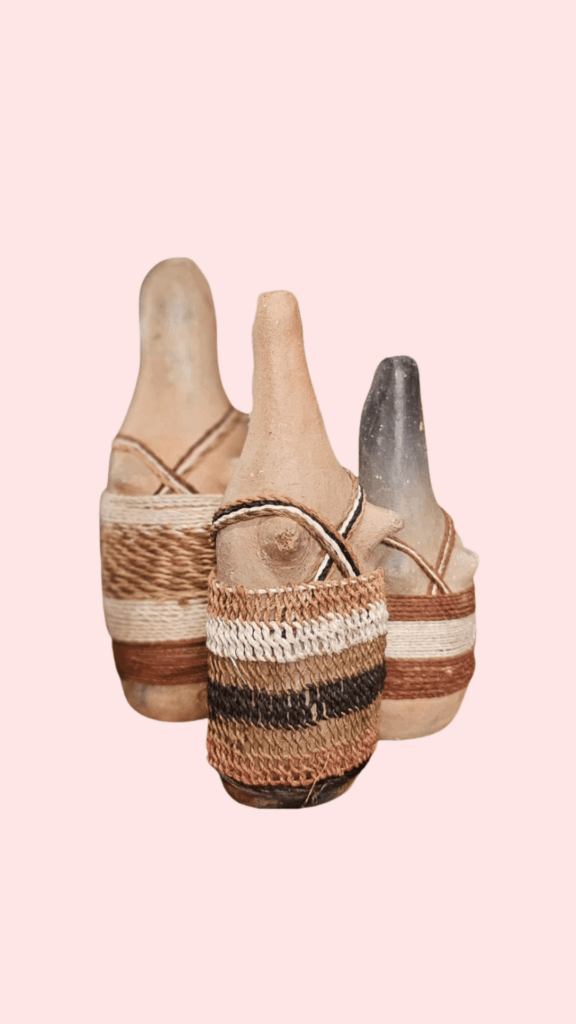
The vatfa clavót — the ancestral clay dolls of the Nivaclé people, shaped by the hands of grandmothers — were never mere playthings. Each figure carried the quiet marks of a living hierarchy, guiding young girls through the transformations of their bodies and the sacred passage into womanhood. They embodied balance and complementarity within the clan, reminding every woman of her essential place in the circle of life, just as every being holds its role in the greater harmony of nature. More than objects, they were vessels of ancestral wisdom, threads of unity, and living bridges of respect between the generations that came before and those yet to come.
Traditional hand-modeled ceramic • One of a kind • Living Indigenous Art
Inventory Record – ICOM Format
Use and Cultural Context
The Vatfa Clavot represent grandmothers as guardians of knowledge, oral memory, and cultural continuity within the Nivaclé people. Traditionally associated with domestic and community settings, they serve pedagogical and identity-related functions and, in some contexts, act as objects of spiritual protection.
Physical Description
Anthropomorphic figure made of hand-modeled traditional ceramic, characterized by a schematic form with minimal or absent facial features. Textile and organic elements may be incorporated into the clothing or surface finish. The formal simplicity reflects symbolic and cultural values rather than realistic representation. Each example shows variations inherent to handmade production.
Cultural Significance
Material and intangible expression of the cultural heritage of the Nivaclé people. The use of traditional ceramic reinforces the connection to land, territory, and ancestral knowledge transmitted through the female lineage.
Dimensions
Height: ___ cm
Width: ___ cm
Depth: ___ cm
Weight: ___ g
Accession Number
(Assigned by Rinconada Studio NFT blockchain registre)
Object Name
Traditional Doll
Title
Grandmothers’ Dolls (Vatfa Clavot)
ICOM Classification
Ethnographic Object – Indigenous Art / Material Culture
Culture / Ethnic Group
Nivaclé people
Cultural Area / Region
Paraguayan Chaco (and Argentine Chaco)
Maker / Producer
Nivaclé women artisans
(collective authorship, intergenerational transmission)
Date / Period
Ancestral tradition; contemporary example (20th–21st centuries)
Place of Production
Nivaclé communities of the Chaco region
Materials
Hand-modeled traditional ceramic, plant fibers, reused textiles, threads, seeds, and natural pigments.
Technique
Hand modeling in traditional ceramic; artisanal firing. Assembly and finishing with organic materials using traditional techniques.
Condition
Good / Fair / Needs conservation (specify)
Conservation History
None recorded / (specify if applicable)
Original Function
Educational, symbolic, and cultural object; transmission of knowledge and community values.
Current Status / Contemporary Context
Living Indigenous art. Ongoing artisanal production linked to cultural preservation and community-based economies.
Provenance
(Direct acquisition / Donation / Field collection / Purchase)
Date: ___
Source: ___
Associated Documentation
Photographs, field records, interviews with artisans (if applicable)
Recommended Display Conditions
Dry and stable environment; controlled humidity; moderate lighting. Avoid impacts and vibrations due to the fragility of ceramic materials.
Cultural / Ethical Considerations
Object of Indigenous origin. Respectful display is recommended, with appropriate cultural context and explicit acknowledgment of the Nivaclé community.
Notes
Each piece should be understood as a unique work, carrying memory and ancestral knowledge, inseparable from its cultural context.
Discover a Unique Gift
Each Rinconada Studio piece is a one-of-a-kind work of ceramic art, hand-sculpted with character, presence, and soul.
Select a unique gift below and click on the piece to view its story, details, and availability.
Choose the piece that speaks to you.